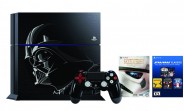
There is a Darth Vader-themed PS4 on the way and it looks awesome

Sony has a Darth Vader-themed PlayStation 4 bundle coming our way. The special edition gaming console will hit the shelves in two guises on November 17, though pre-orders are due to begin soon. The Star Wars Battlefront limited edition PlayStation 4 bundle will consist of a 500GB console with an image of Darth Vader and a gaming controller inspired by the Sith lord's chest panel. Content-wise, buyers will get Star Wars Battlefront Deluxe Edition and download voucher for Super Star Wars, Star Wars: Racer Revenge, Star Wars: Jedi Starfighter and Star Wars Bounty Hunter. The classic games will be playable on on PS4 for the first time. Walmart on the other hand, will exclusively offer the console with Disney Infinity 3.0 Edition and the above four classic titles. Additionally, the bundle will include four action figures of characters from Star Wars. There is no word on pricing of the decked out PlayStation 4. It is reasonable to expect a price premium over the regular console. Source...


Source: http://www.gsmarena.com/there_is_a_darth_vaderthemed_ps4_on_the_way_and_it_looks_awesome-news-13578.php

Best Apps and Games of the Week

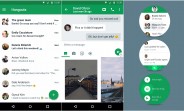
Here are some of the best apps and games of the week. Hangouts Hangouts for Android has received a major update with version 4.0. The major change here is the UI, which has a fresher, cleaner look. The new + button lets you quickly message your recent contacts or start a new group or video call. The conversation view makes better use of negative space to give a less cluttered look. There is a new image picker that is much nicer than before. There is also a brand new Android Wear app that shows your conversations and groups and you can reply using voice or send an emoji from the watch itself. Price: Free Download: Android Robinhood Robinhood is a service that lets you trade on the stock market for free without paying the $10 fee. You can trade stocks from your favorite companies from within the app and it shows you all the market data and quotes in real-time. The app lets you build a personalized stock watchlist with historical market data and detailed charts and you can place market, limit, stop loss, stop limit, and good till canceled orders. The app also uses color schemes to inform if the market is open or close. The app can be locked with a PIN and all information is fully encrypted using SSL. On top of that, the app uses beautiful Material Design elements and looks truly stunning. Price: Free Download: Android Plex Plex for iOS got a major update with version 4.0 and is redesigned from the grounds up. Plex is a media player that organizes and streams all your music from your Plex server on your computer to your devices. In version 4.0 you get a brand new interface that is visually more attractive and also easier to navigate and use. It's also faster and has loads of new features. Price: Free Download: iOS Fallout Shelter After releasing on iOS earlier, Fallout Shelter is finally on Android. Fallout Shelter is a simulation game; basically SIMS, but underground. You are the overseer of the Vault and your aim is to manage the people living inside the Vault and to keep them happy. You can perform various activities in the game through the people living in there and you have to sustain, grow and protect the community and structure within the vault. Price: Free Download: Android Gathering Sky Gathering Sky is a simple game where you guide a flock of birds across the windy sky, gathering more birds as you go along. There really isn't much of a goal here and the game is meant for relaxed gameplay, with a beautiful background score accompanying you. Price: $2.99 Download: iOS • Android Sputnik Eyes Sputnik Eyes is a puzzle game where you have to move the 'Eyes' along the paths so that each one matches up with its right color position to complete the level. Price: $2.99 Download:...


Source: http://www.gsmarena.com/best_apps_and_games_of_the_week-news-13577.php

Top ten fan favorites phones of the month

If you frequent our website then you have undoubtedly noticed the fresh new look we...


Source: http://www.gsmarena.com/top_ten_fan_favorites_of_the_month-news-13556.php

Weekly poll: Samsung Galaxy Note5, S6 edge+ - hot or not

Next is now, and has been so for four days since the official launch of Samsung's top-of-the-line phablets. And that's a plural for a second year in a row, the Galaxy Note5 and Galaxy S6 edge+ succeeding the Note 4 and, in a way, the Note Edge. A lot has changed in 2015, and critics will have plenty to cling to with this generation. More importantly, devoted brand fans have been heard questioning their loyalty, and the upgrade is not an automatic decision. Of course, it's very early to be making statements now, since we don't actually have much objective data. That said, a specsheet and a bunch of photos are a pretty solid base to answer our customary poll question - "Hot or not?". Samsung Galaxy Note5 Glass has made its way to the top-shelf phablet, much to the disappointment of die-hard Note fans. The faux leather is gone and has taken with it the user-replaceable battery and the microSD slot, shattering the hopes that the Note5 will stick to the series' core. Other than that, it is a Note through and through, with a large 5.7-inch Super AMOLED display, S Pen as good as ever, improved Air command menu, and the most powerful hardware available. So is the Galaxy Note5 still the productivity king, or has it swayed a bit too much towards form, abandoning function? Oh, wait, the actual question is different. Samsung Galaxy S6 edge+ The Galaxy S6 edge+ has less promise to live up to and generally doesn't carry as much responsibility, though Samsung's accounting would say otherwise. It's targeted at a more light-spirited user, with priorities in looks and good old fun, and yet it packs the same powerful innards. Sounds like an easy sell, what do you...


Source: http://www.gsmarena.com/weekly_poll_samsung_galaxy_note5_s6_edge__hot_or_not-news-13554.php

Counterclockwise: taking Note of history

The new Galaxy Note was unveiled this week, so we decided to look back at the history of one of the most successful phablets. It wasn't the first, but it's credited with the resurrection of the stylus (the capacitive touchscreen on the iPhone gets credit for killing it). Looking back through archives we can't help but notice that mid-August was historically rich on rumors and leaks about the Note, though basically nothing official. That's because Samsung reserved the Galaxy Note unveiling for IFA, except this year when it was pulled forward. We'll get to the reason why, but let's start at the beginning. 2011: Samsung Galaxy Note Back in 2011 DLNA certification revealed the Samsung I9220, "expected to come running Gingerbread 2.3.3 with a 4.3" Super AMOLED rumored to have a 1280x720 resolution." Well, that guess at the screen size was off by a full inch. The Samsung Galaxy Note had a 5.3" Super AMOLED display with 800 x 1,280px resolution and Wacom digitizer. Wacom is well-known for making graphics tablets used by digital artists and Samsung was promising a great handwriting experience with its new gadget. The phablet itself was a beefed up version of the Galaxy S II. Samsung settled on a two launch schedule - the Galaxy S will rule the first half of the year, the Galaxy Note will be the H2 update. Both gadgets build on the specs of the previous one and would introduce features to be adopted by the next one. 2012: Samsung Galaxy Note II A year later we were hearing about the potential updates to the screen - a 5.5" AMOLED display, built on an "Unbreakable Plane (UBP) and plastic substrate." The display was supposedly flexible, which would allow Samsung to create a curved screen. Well, that didn't pan out, but looking back it's clear that Samsung has been working on this tech for years before the Galaxy Note Edge showed up. Back to the Samsung Galaxy Note II. It indeed increased the screen size to 5.5" but dropped the resolution to 720 x 1,280px (moving from 16:10 to 16:9 aspect ratio). It doubled the CPU cores and the RAM, but was otherwise a fairly small update. The S Pen was redesigned, allowing the Note II to detect it from a small distance, enabling Air View and other gestures. Curiously, around that time it was suggested that Samsung might be interested in buying BlackBerry, which both companies denied. While it hasn't changed its mind yet, Samsung unveiled a hardware QWERTY add-on for the new Galaxy S6 edge+, which draws some comparisons to BlackBerrys of the past. 2013: Samsung Galaxy Note III Another 0.2" bump in screen size brought the Galaxy Note display to its final size - 5.7". The resolution would have been increased to 1080p (finally a bump in pixel density) and the CPU cores would be doubled again, at least in the Exynos version. After the Galaxy S III/Note II generation, Samsung started moving away from its own Exynos chipsets and onto Snapdragons, because consumers wanted LTE and Exynos didn't have the right modem. The 8MP camera of the previous two models was dropped for a 13MP one. It improved on Galaxy S4's 13MP camera with the addition of 2160p video capture. The Note III also jumped on USB 3.0, though that didn't last. Another introduction, one that would actually catch on, was the Flip Covers with a window, allowing notifications to be shown while also keeping the screen safe. 2014: Samsung Galaxy Note 4 and Note Edge The Galaxy Note III had faux leather farmed in faux metal. The Samsung Galaxy Note 4 would make that real metal, shortly after the Galaxy Alpha went there first. Anyway, the screen size stayed the same, but it was time for another resolution bump - QHD or 1,440 x 2,560px. This model improved the camera again, going up to 16MP and adding optical image stabilization (a first for a Samsung phone outside of camera hybrid novelties). There were plenty of rumors about a second version of the Note, one with a three-sided display. That was one side too many, but the Galaxy Note Edge introduced the world to screens with a small, practical curve on one side. Finally the rumors that have been going on since Note II times materialized. The side curve was used for notifications, gestures and shortcuts and ultimately it was a testing ground for the dual-curved Samsung Galaxy S6 edge that came out half a year...


Source: http://www.gsmarena.com/counterclockwise_taking_note_of_history-news-13545.php

The rise, dominance, and epic fall - a brief look at Nokia's history

A couple of years ago, Microsoft reached a deal to acquire Nokia's struggling devices and services business, and just recently, the Finnish company sold its HERE mapping unit to a group of German car-makers. It's true that Nokia had terrible last five years, but this doesn't take away the fact that it was this very company that effectively defined the mobile industry for over a decade prior, and gave us some of the most memorable phones. In this article, we take a trip down memory lane to revisit Nokia's history, which - hold your breath - spans a whopping 150 years. Humble beginnings While Nokia may remind most of us of only mobile phones, the company in fact started out as a paper mill, which was established in 1865 by mining engineer Fredrik Idestam at the Tammerkoski Rapids in south-western Finland. However, the name Nokia wasn't yet born. It was the location of his second mill - on the banks of the Nokianvirta river - that inspired Idestam to name his company Nokia Ab, something which happened in 1871. After around three decades, the company also ventured into electricity generation. Meanwhile, Eduard Polón founded Finnish Rubber Works in 1898, and Arvid Wickström established Finnish Cable Works in 1912. In 1918, Finnish Rubber Works acquired Nokia to secure access to the latter's hydro-power resources, and in 1922, Finnish Cable Works was also acquired by the newly formed conglomerate. While the three companies were jointly owned, they continued to work independently until 1967, when they were finally merged and Nokia Corporation was born. The newly formed company mainly focused on four markets: paper, electronics, rubber, and cable. It developed things like toilet paper, bicycle and car tires, rubber footwear, TVs, communication cables, robotics, PCs, and military equipment, among others. Portfolio expansion In 1979, Nokia entered into a joint venture with leading Scandinavian color TV manufacturer Salora to create Mobira Oy, a radio telephone company. A few years later, Nokia launched the world's first international cellular system dubbed Nordic Mobile Telephone network, which linked Sweden, Denmark, Norway, and Finland. This was followed by the launch of the company's as well as world's first car-phone dubbed Mobira Senator, which weighed in at around 10 kg. In 1984, Nokia acquired Salora and changed the name of its telecommunications unit to Nokia-Mobira Oy. The year also marked the launch of Mobira Talkman, which was advertised as one of the first transportable phones. This means it could be used both in and out of car, although it was still around 5kg. Three years later, the company introduced its first compact phone called Mobira Cityman 900, which was also the world's first hand-held mobile telephone. Despite weighing around 800g and carrying a price tag of around $5,456, it sold like hot cakes. The phone became iconic and was nicknamed "The Gorba" after the then Soviet Union president Mikhail Gorbachev used it to to make a call from Helsinki to Moscow during a press conference in October 1987. The following year brought a tough phase for the company as it witnessed sharp drop in profits owing to severe price competition in the consumer electronics markets, and its chairman Kari Kairamo committed suicide reportedly due to stress. The new leadership brought changes, dividing the company into six units: telecommunications, consumer electronics, cables and machinery, data, mobile phones, and basic industries, while divesting other units like flooring, paper, rubber, and ventilation systems. In 1989, Nokia-Mobira Oy became Nokia Mobile Phones. Change in focus - mobile phones In 1990's, Nokia's top leadership decided to focus solely on the telecommunications market, and as a result, the company's data, power, television, tire, and cable units were sold off in the first few years of the decade. In 1991, world's first GSM call was made by the then Finnish prime minister, Harri Holkeri. Unsurprisingly, it was made using Nokia equipment. The next year, the company's first hand-held GSM phone Nokia 1011 was launched. The device reportedly had a talk time of 90 minutes and could store 99 contact numbers. It was also known as Mobira Cityman 2000. A couple of years later, the company launched its 2100 series of phones, which were also...


Source: http://www.gsmarena.com/the_rise_dominance_and_epic_fall__a_brief_look_at_nokias_history-news-13460.php

Popular Posts

Related Posts Plugin for WordPress, Blogger...